




How much would you give up for a phone you barely notice in your pocket? Apple’s iPhone Air is a $999 attempt to answer that question with real money. At 5.6mm, it is the thinnest iPhone ever made, a slab of titanium and glass that looks closer to a design concept than a product meant for a mass market. Apple has spent years selling buyers on bigger cameras, bigger batteries and brighter screens, so a flagship built around subtraction is a clear break from the usual upgrade pitch. The Air does not try to win a spec sheet fight. It asks whether people will accept a handful of compromises in exchange for a device that feels almost weightless next to the Pro models.
Thin is easy to admire and much harder to buy.
The Air carries a 6.5-inch display, an A19 Pro chip, a titanium frame and Ceramic Shield glass on both the front and back. Almost everything that makes it thin comes from how Apple arranged the internals: the processor and key components sit in the raised camera plateau at the top, which leaves the rest of the body free to shrink. The price lands between the standard iPhone 17 and the iPhone 17 Pro, and that placement matters. This is not a budget model or a niche accessory. It is a flagship-priced phone that deliberately offers less hardware than the cheaper phone beside it, and Apple is betting that design alone can justify the gap.

What Disappears at 5.6 Millimeters
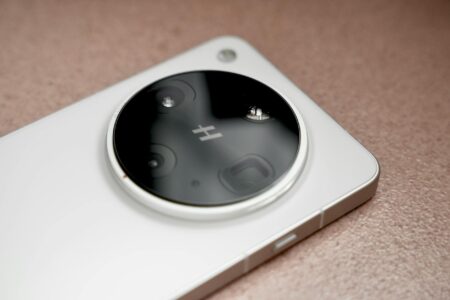
The most visible cut is the camera system. Where the standard iPhone 17 and the Pro models stack multiple lenses, the Air has a single 48-megapixel rear camera, which means no dedicated ultrawide and no telephoto. For casual photography in decent light, one good sensor covers a surprising amount of ground, and Apple’s software crops and processing stretch it further. But anyone who regularly shoots wide group shots, tight architectural frames or distant subjects will feel the missing lenses quickly. The Air also gives up a physical SIM tray, so it is eSIM-only, and its speaker setup is more modest than what a thicker chassis can hold. Each of those is a small loss, but together they add up to a phone that asks you to think about what you actually use.
Battery is the other pressure point. A phone this slim cannot hold a large cell, and no amount of chip efficiency fully erases that physical limit. Apple has pointed to efficiency gains from its A19 Pro processor and its own in-house wireless and modem silicon to make the battery stretch through a full day of ordinary use. It also sells an optional MagSafe battery pack designed to snap onto the back of the Air. That accessory is revealing, because it quietly concedes the tension at the heart of the product: the thinness that sells the phone is the same thing that makes extra power a reasonable thing to carry.
None of this makes the Air a bad phone. It makes it a specific one. The buyer who suits it spends most of the day messaging, browsing, streaming and taking everyday photos, and who values how a phone feels in the hand over how many lenses are on the back. That person may well be happy to trade a telephoto they rarely use for a lighter, slimmer device. The problem is that most people do not know which kind of user they are until they run out of battery at 6 p.m. or want to zoom in on a stage from the back row. Thin phones ask buyers to predict their own habits honestly, and that is a harder pitch than simply promising more.

A Hard Sell Against a Long Memory
Phone makers have chased thinness before, and the history is a mixed one. For several years in the early 2010s, shaving fractions of a millimeter off a handset was a legitimate marketing contest. The race cooled as batteries became the bottleneck and buyers started caring more about getting through a day than about how a phone looked on a spec chart. Apple’s own iPhone 6 era is a reminder of what can go wrong, since its slim aluminum body became the subject of widespread bending complaints. The Air’s titanium frame and reinforced glass are clearly designed with that memory in mind, but the doubt is not entirely unfair. Samsung also pushed into the territory with the Galaxy S25 Edge earlier in 2025, which means ultra-thin is no longer a novelty but a small, contested category.
There is also the case problem. A large share of iPhone owners put their phones in protective cases, and a case adds bulk that erases much of the thickness advantage the Air was built around. Attach a battery pack and the phone grows again. Reports from the supply chain have suggested demand for the Air has been softer than for the other iPhone 17 models, with Apple reportedly adjusting production plans, though Apple has not published sales figures for individual models and those claims should be read with caution. If the pattern holds, it would suggest that the people most excited about thin hardware are not necessarily the people most likely to pay flagship money for it.
Apple has run this kind of experiment before. The iPhone mini was built on the idea that a meaningful group of buyers wanted a smaller phone, and it was reportedly discontinued after sales failed to justify the line. The Plus models have stuck around in various forms because larger screens clearly attract buyers. The Air sits somewhere in between: it is not trying to be small, only slim, and it is priced as a premium object rather than a compromise. That makes it a cleaner test than the mini was. If buyers still pass, it will be hard to blame the price tier or the screen size, and Apple will have learned that thickness, by itself, is not the feature people were waiting for.

The Real Test Comes Next
Apple can survive a quiet Air. What it cannot afford is to build a folding iPhone, widely rumored and dependent on thin hardware, on the assumption that buyers crave slimness when its own thinnest phone may be showing that they do not.
Frequently Asked Questions
How thin is the iPhone Air?
The iPhone Air measures 5.6mm thick, making it the thinnest iPhone Apple has released. It uses a titanium frame and Ceramic Shield glass on the front and back.
What does the iPhone Air give up to be so thin?
It has a single rear camera instead of a multi-lens system, an eSIM-only design with no physical SIM tray, and a